
The Fuel System, Part 2 of 4
Read time: 6 minutes
Under the Hood is a weekly look at what's really driving your health, fixed 1% at a time.
Today: my animal-based diet experiment, what fat actually does for you, the four types of fat, and how much you need.
A few years ago, I got really into the animal-based diet. If you know me, you know I love to experiment.
It's built on five foods: meat, organs, fruit, honey, and dairy. I did it for several months, and on the outside, things looked great. I was getting leaner. I felt good and had great energy.
But I hadn't looked under the hood.
At my physical, my doctor ran my bloodwork. Everything looked good except one number. My LDL cholesterol was almost 400.
“You need to stop that immediately,” he said. “I've never seen this in my entire practice.”
THE DEEP DIVE
What was happening under the hood.
My triglycerides were low. My A1C was great. I was metabolically healthy, except my LDL was through the roof.
We found the cause: familial hypercholesterolemia, or FH. It's genetic. My body already makes too much cholesterol, and a high saturated fat diet on top of that sent my numbers through the roof. (New here? I shared the full story in Issue #1.)
FH isn't rare. About 1 in 250 people have it, and about 90% don't know. If your LDL is above 190, ask your doctor about it.
Not all LDL is the same, either. The small, dense particles, the bullets, are driven more by sugar and processed carbs. Saturated fat mainly raises the large, fluffy ones. But fluffy doesn't mean harmless. When you've got too many particles, even the big ones add up. That was me.
What I do now.
Today I work closely with my doctors. I'm on Repatha, plus a low-dose statin or Zetia, and my numbers have come way down.
The ones I watch most are ApoB and Lp(a). ApoB counts the particles that can end up in your arteries, and it predicts heart disease better than LDL alone. For me, getting it down means medication, leaner meats, and keeping saturated fat around 25 grams a day.
The animal-based diet might work great for someone else. For my body, it wasn't the right long-term plan. Work with your own doctor. What works for me may not be right for you.
Have you checked your LDL, ApoB, or Lp(a) in the last year?
We blamed the wrong thing.
For decades we were told fat was the enemy. Part of that story was paid for: in 1967, the sugar industry funded a Harvard review that blamed fat and played down sugar.
The type of fat matters more than the amount.
The four types of fat.
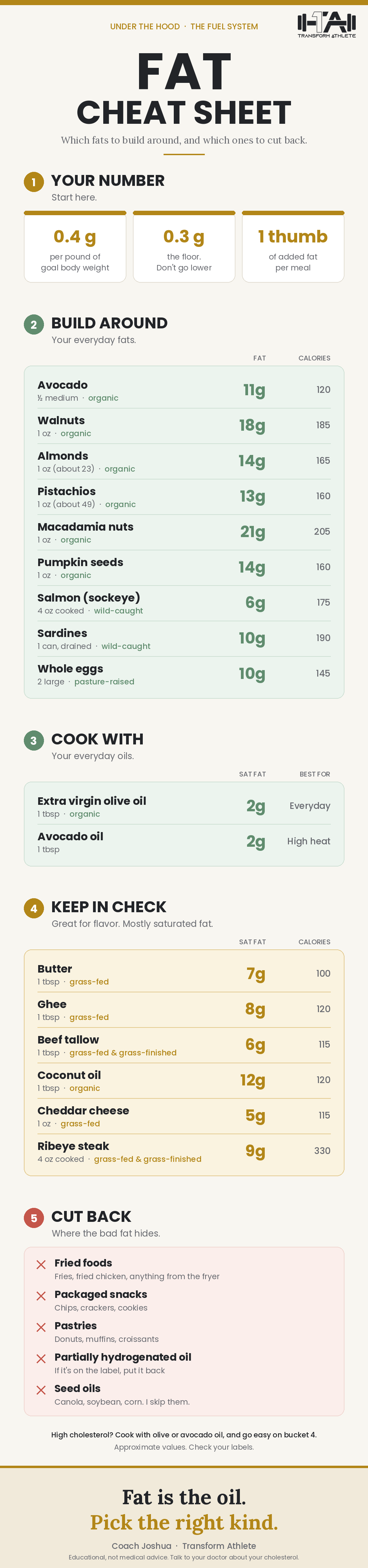
Monounsaturated: olive oil, avocado, nuts. Build around these.
Polyunsaturated: omega-3s from fatty fish, walnuts, and flax. Your brain and heart love these.
Saturated: butter, cheese, fattier red meat. Not the devil. Just keep it in check, especially if your cholesterol runs high.
Trans fat: the worst. The FDA banned the main source in 2018, but it still hides in fried and packaged foods. If a label says “partially hydrogenated,” put it back.
Your olive oil might not be olive oil.
In a UC Davis study, 69% of imported “extra virgin” olive oils failed to meet extra virgin standards.
When you buy it, look for a harvest date, a dark bottle, a fresh peppery taste, and one country of origin, not a blend.
The oils I cook with.
Every day: extra virgin olive oil. Avocado oil for high heat.
For flavor, in small amounts: grass-fed butter, ghee, and tallow. They're mostly saturated fat, so with my cholesterol, I keep them small.
What I skip: seed oils like canola, soybean, and corn. That's my personal choice. The bigger problem is where they show up: fried food and packaged snacks.
What fat actually does.
If protein is the parts, fat is the oil. You don't run an engine without it.
It builds your hormones. Your body makes testosterone from fat. Men on low-fat diets had lower testosterone than men eating more fat.
It feeds your brain. About 60% of your brain's dry weight is fat.
It keeps you full. At 9 calories per gram, a little goes a long way. A handful of nuts, not the whole bag.
It's your slow-burning fuel. At an easy pace, fat is your main fuel. When you go hard, carbs take over.
How much fat you need.
Goal body weight × 0.4 = grams of fat a day.
Don't go below 0.3. For a 180-pound goal, that's about 70 grams.
This isn't from one study. It's the research ranges turned into one simple number. It keeps you in the 20 to 35% range most experts recommend, and above the levels where testosterone starts to dip.
Haven't set your protein yet? Start with last week's issue.
QUICK HITS
TRAINING — Skip the big, fatty meal right before a hard session. Fat digests slowly and can leave you feeling heavy.
FAMILY — FH runs in families. If a parent has it, each child has about a 50% chance. One blood test could change your kid's future.
MIND — The omega-3s in wild-caught salmon, sardines, and walnuts are part of your brain's structure. Aim for a couple of servings a week.
THIS WEEK'S 1%
Make one swap: cook with olive oil instead of butter, or eat wild-caught salmon twice this week. Pick one and do it all week.
Next week, Part 3: carbs. Which ones to build around, and what sugar really does.
Know a guy who's been eating “fat-free” since the '90s? Forward this to him. When he signs up here, he'll get my free Lean in 90 guide.
Your body is worth stewarding.
1% BETTER
— Coach Joshua
Educational content, not medical advice. Partner with your physician, ideally one who believes in proactive care. If you have high cholesterol or heart disease, talk to your doctor before changing your diet.
New here? Every issue lives in the archive. Last week I covered how much protein you actually need.